






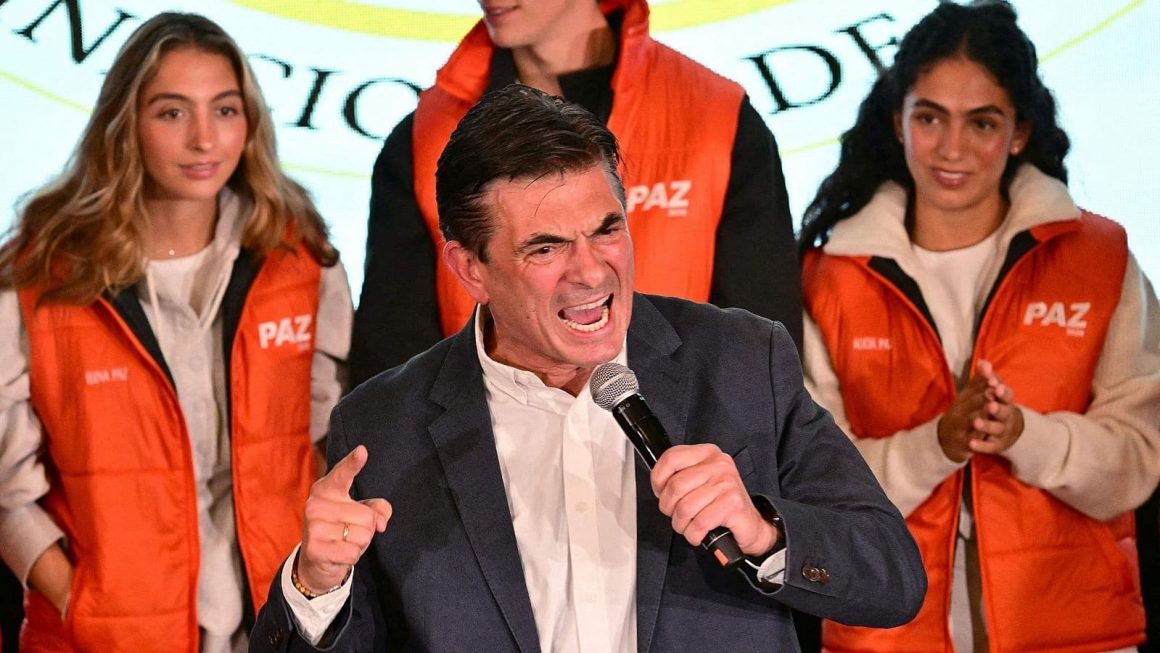
The result of the second round of elections in Bolivia on October 19 could be understood as a shift to the right, within the typical pendulum swing between left and right that often defines the political vocabulary in use. What is certain is that there were elections, a second round, and a president-elect with 54.6% of the vote: Rodrigo Paz Pereira. However, beyond the greetings to the United States and gestures such as not inviting Nicolás Maduro’s government to the inauguration.
Rodrigo Paz Pereira, son of former president Jaime Paz Zamora and grandnephew of Víctor Paz Estenssoro, comes from one of Bolivia’s most renowned political families. He was mayor of Tarija and a national senator, and although he has built his own career, it is difficult not to associate him with the legacy of his father, the emblematic “Gallo” Jaime Paz Zamora, founder of the Revolutionary Left Movement (MIR), a party registered with the Socialist International. Paz Zamora had to distance himself and, in order to become president, it suited him to present himself as a centrist, representing those who “want profound changes to escape the misery into which these ideological struggles have led us.” Indeed, that message proved successful, and his victory expresses a demand for renewal rather than ideological adherence: as much state and as much market as necessary could be his motto. This pragmatism has governed his political career: he was a member of the MIR (2002-2006), was independent from 2006 and later participated in alliances with Podemos (2005-2008), Comunidad Ciudadana (2020-2025) and the Christian Democratic Party (PDC), with which he finally won the presidency. Like someone who takes different taxis to get to a predetermined location, Paz chose his route well and reached his destination.
Thus, a candidate who before the first round did not even reach 8% in the polls is preparing to take command of a country without dollars, with international reserves at historic lows, fuel shortages, unsustainable subsidies, 0.6% growth, and 20.8% inflation. Added to this is a fiscal deficit of more than 9% of GDP and an economy virtually paralyzed by the loss of purchasing power and lack of confidence.
The challenge for Paz is enormous, as great as his optimism. With the same conviction he showed during the campaign, in his first press conference as president-elect he revealed that he has been in talks, especially with the United States and other friendly countries. It seems to be off to a good start: the United States and eight Latin American countries have expressed their support for a change of course in Bolivia’s economic management.
But in addition to the backing he is receiving from outside the country, the new president will need internal support to ensure governability. Although the Christian Democratic Party (PDC) is the largest force in parliament, it does not have an absolute majority, which is why it will have to build consensus with the Free Alliance bloc, which supported Jorge “Tuto” Quiroga, and the self-defined centrist National Unity bloc, led by former candidate Samuel Doria. Both blocs are still deciding whether to act as opposition or to join eventual coalitions. The real challenge will be to transform that relative majority into an effective capacity to govern, capable of carrying out an agenda as ambitious as it is risky, with which Paz will have to make his proposal of “Capitalism for all” a reality. This campaign slogan promised “cheap loans for entrepreneurs, lower taxes and tariffs on imports of technology and vehicles, as well as ending the ‘blocking state’ and allocating 50% of the general budget directly to Bolivia’s nine regions.” Added to this is another sensitive issue: the plan to phase out fuel subsidies, a campaign promise that is likely to be one of the most difficult to implement, as it will test his ability to engage in dialogue with the social sectors that brought him to power.
Certainly, after two decades of hegemony by the Movement Toward Socialism, there are high expectations about the direction Bolivia will take in the coming years. Tensions are no less intense in a country where Evo Morales continues to have a strong presence in politics, the media, and social networks. On election day, after the results were announced, the coca grower leader wrote on X: “Paz and Lara won with the Evo vote.” He warned that Evo’s supporters did not give a blank check and demanded the continuity of the Plurinational State, social achievements, and the anti-neoliberal and anti-imperialist spirit.
Closing the page on the electoral issue, it is worth noting that the distribution of votes did not necessarily revolve around ethnicity, as is often assumed to be the case in Bolivia. In fact, analyst Carlos Toranzo refers to a decline in identity discourse, explaining that the country is currently defined as predominantly urban and mestizo. Along the same lines, it is worth remembering what academic Fernando Untoja has been warning for some time: identity discourse was a “political tool to impose an authoritarian model under the pretext of indigenous Marxism.”
Bolivia has entered a new political era, with a pragmatic leader who won in MAS strongholds such as La Paz and Cochabamba, but not in Santa Cruz, a traditional adversary of “Evismo” where Tuto Quiroga won the majority of votes. Quiroga was a candidate feared for his possible neoliberal “shock” policies, as the left of the 1990s would say, which raises questions about future political alliances in the face of Morales’ influence. In this scenario, the fact that ethnic identity is no longer the dominant factor in voting favors a focus on other concerns, more closely linked to the economy and the management of the state. It remains to be seen whether Rodrigo Paz Pereira will maintain an equidistant stance toward politicians who are completely opposed to each other, such as Quiroga and Morales, which seems unlikely given the need for alliances, or whether he will try to act in accordance with complex realities that require a high degree of consensus and governability.