







Towards a New World Order
In a book that seems forgotten today but was a bestseller in the 1990s, Samuel Huntington anticipated the world of the 21st century. According to the American political scientist, there was little the West could do to control the post–Cold War order. The best option for our civilization, he argued, was a strategic retreat.
In The Clash of Civilizations, Huntington argued that Western civilization was losing global relevance due to its low birth rates and the transfer of technology. The combined GDP of the West was also shrinking in comparison with the rise of large emerging economies. With the exception of Spanish, all Western languages were in decline, spoken as a mother tongue by an ever-smaller percentage of the world’s population.

And although his concept of “civilization” was questioned, the “fault lines” identified by Huntington have strongly resurfaced in the conflicts of the present century. For example, the division of Ukraine he foresaw between the Russian-speaking East and the pro-European West is clearly reflected today in the map of the war devastating that country.
Both Russian revisionism and Islamic expansion concerned Huntington. However, his main preoccupation always revolved around the consolidation of China as a major global power and a direct rival to the United States.
The Asian Vision of the World
No one doubts China’s power today. With patience, foresight, and tenacity, China has consolidated its pre-eminence over what traditional geopolitics called the “Eurasian pivot.” And although the pro-American containment belt formed by Japan, South Korea, and Taiwan still limits China’s full control of the Asia-Pacific, its technological and military strengthening is advancing in tandem with its strategy of global influence.
Alongside the “String of Pearls” and the “New Silk Road,” the Shanghai Cooperation Organisation (SCO) constitutes a pillar of this strategy. If the first two initiatives allow China to control the main commercial access routes to the world, the SCO provides a political framework for exercising its influence across Asia. From its embryonic phase (the Shanghai Five in 1996) to its formal creation in 2001, the SCO has become the principal mechanism for international cooperation on the Asian continent.
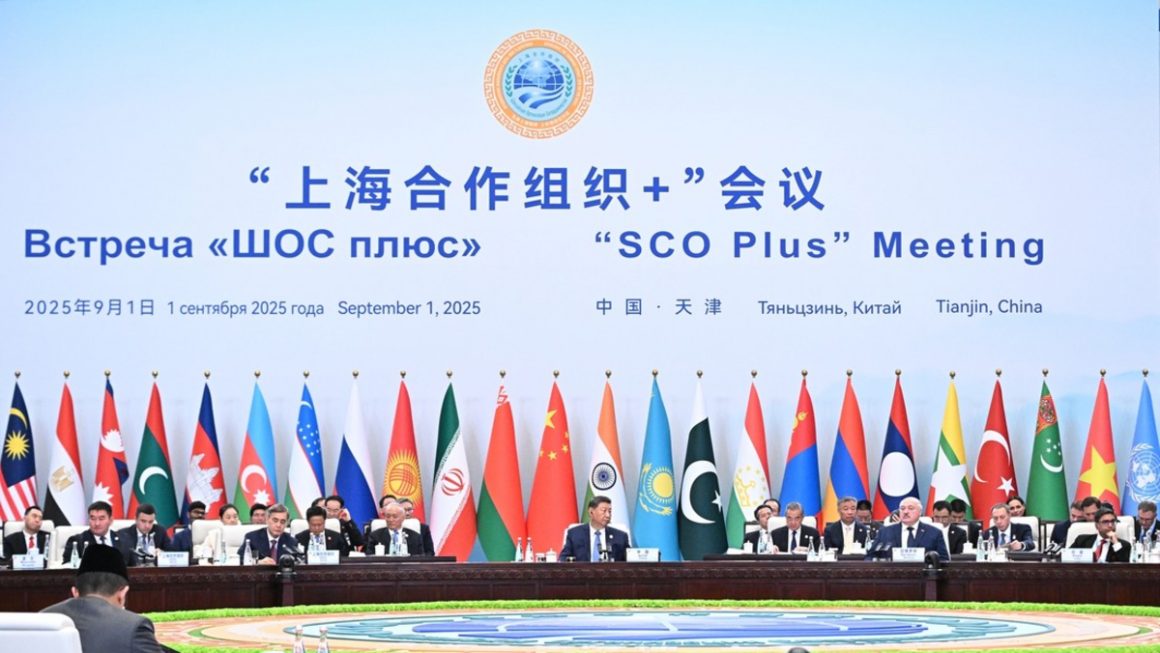
Just over a month ago, this organization held its 24th Summit in the Chinese city of Tianjin. Representatives of the ten current SCO member states—China, Russia, India, Pakistan, Iran, Uzbekistan, Turkmenistan, Kazakhstan, Kyrgyzstan, and Belarus—met there for two days. Five of these countries are among the ten most populous in the world. The organization represents 40% of the world’s population and more than 25% of global GDP. Its official languages are Chinese and Russian.
Distinguished guests not (yet?) integrated into the SCO also attended the Tianjin summit. Alongside the prominent roles of hosts Xi Jinping and Vladimir Putin, notable guests included Tayyip Erdoğan, Mostafa Madbouly, and Prabowo Subianto—the presidents of Turkey, Egypt, and Indonesia, respectively. Even UN Secretary-General António Guterres traveled there, two weeks before the 80th session of the United Nations General Assembly.
The meeting of these prominent figures demonstrates, on the one hand, the weight that China already exerts across Asia in economic and geopolitical terms—a role that, incidentally, aligns with how Chinese civilization has always viewed itself (the term “China” originally means “Middle Kingdom”). The commercial integration that Beijing has built across Eurasia, reinforced by the war in Ukraine, now seems difficult to reverse.
On the other hand, the Tianjin summit reflects the consolidation of what we could call an “Asian vision of the world.” In this view, the defense of democracy and human rights is no longer a priority, while security, internal order, economic growth, and the absolute pre-eminence of leaders who often perpetuate themselves in power certainly are. This convergent vision, led by China, was on full display at the SCO summit, which Beijing used to align the Asian continent ahead of the UN’s annual gathering in New York.
The Asian consensus produced by this shared worldview is capable of making bitter enemies such as India and Pakistan jointly sign a declaration that uses identical terms to denounce recent terrorist acts in Kashmir. The declaration also expresses the common Asian rejection of “trade disputes,” the “Cold War mentality,” and the “unilateral coercive measures” that SCO members attribute to the Western world. In the same spirit, the Tianjin declaration condemns Israeli and American actions in Gaza and Iran but makes no mention of the war in Ukraine.
As an alternative to the Western-led world order, Xi Jinping called for progress toward “a more just and equitable system of global governance,” based on the principles of “sovereign equality, respect for international law, multilateralism, a people-centered approach, and advances in concrete measures.” Indeed, his proposal was very concrete: the creation of an SCO Development Bank through which member countries could receive, this very year, $1.4 billion in loans and an additional $280 million in grants.
Putin also made clear pronouncements. After the previous meeting with Trump in Alaska on August 15, from which no concrete results emerged, the Russian leader reiterated in Tianjin his defense of a “multipolar world.” Since then, several NATO countries (Finland, Latvia, Lithuania, Norway, Poland, Romania, Denmark, Germany…) have reported the presence of Russian drones in their respective airspaces, while Moscow conducts the Zapad (“West 2025”) military exercises in Belarus, in which India also participated.
Implications for the West
While Asian regimes seem to find their best representative and interlocutor in China, the West is fracturing. In Europe and Latin America, the perception is growing that while China and the SCO offer ever more loans and investments, the United States imposes tariff adjustments that benefit only itself, even as it readjusts the terms of cooperation in multilateral organizations. There is even the paradox that today Beijing often preaches free trade more vehemently than Washington.
The reason for this progressive inversion of roles is clear. By financially and militarily sustaining—for decades—a global multilateral and economically integrated order, the United States has borne the internal costs of that leadership in the form of deindustrialization, job losses, and fiscal imbalance. China, by contrast, has emerged as the largest and most prominent beneficiary of that imbalance—reaping technology transfers and commercial advantages.
All this was vividly reflected in the recent 80th session of the United Nations General Assembly. There, Trump questioned the usefulness of the organization, of which his country is the main financier but which—he claimed after various mishaps during the meeting—“only provides him with non-functioning escalators and teleprompters.”
The American president also made no effort to conceal his discontent and weariness with the European Union and the actors involved in the war in Ukraine, given the difficulties faced by the EU, Russia, and Ukraine in reaching a negotiated settlement. In a public message, he wished them “good luck, everyone” with that issue, inviting Zelensky to seek European funding to continue the war against Putin.
In the international realignment he is pursuing, Trump extends a hand only to those willing to share the costs. He arrived in New York after closing a deal with post-Brexit Britain that includes major technology investments and after offering Javier Milei a financial rescue worth $20 billion.
In strictly geopolitical terms, Trump appears determined to refocus his efforts on the American continent, where China has already become the main trading partner of all of South America, and Russia is stirring the authoritarian triangle formed by Cuba, Nicaragua, and Venezuela. At the same time, Latin American cartels are flooding the United States with fentanyl made from chemical precursors imported from China and deploying operatives on U.S. soil.
In this sense—and without ruling out his interest in acquiring Greenland—Trump’s geopolitical priority in the hemisphere is the definitive control of the Caribbean basin. After renaming the Gulf of Mexico and taking control of the Panama Canal from the Chinese, he is now mobilizing military contingents to subdue the regime of Nicolás Maduro, in a country rich in natural resources and crucial for closing the Caribbean Sea to extra-continental powers.
Ultimately, faced with the rise of China and the Asian consensus—and in his effort to awaken Europe and regain control of the Americas—Trump appears to be orchestrating a strategic retreat that echoes Huntington’s diagnoses and predictions, now more relevant than ever.